Madness is rare in individuals — but in groups, parties, nations, and ages it is the rule.
— Friedrich Nietzche
Madness is rare in individuals — but in groups, parties, nations, and ages it is the rule.
— Friedrich Nietzche
What’s the difference between in and out?
A wall with delusions of grandeur
Question Mark Harris, Answer Michelle Tennison (2016)
— Jane Wagner
Bally Jerry pranged his kite right in the how’s-your-father; hairy blighter, dicky-birded, feathered back on his sammy, took a waspy, flipped over on his Betty Harpers and caught his can in the Bertie.
Eric Idle, 1974
Rhetoric does not get you anywhere, because Hitler and Mussolini are just as good at rhetoric. But if you can bring these people down with comedy, they stand no chance.
— Surrealist Proverb, Paul Eluard and Benjamin Peret
Will all my questions ever be answered?
Mere pebbles in the beginning, a landslide by its end
Q&A Session with Paul Cunniff, Sharon Cunniff, Mary Ellen Binkele, and Michelle Tennison
The overwhelming majority of the universe is: who knows?
— Richard Panek, The 4 Percent Universe: Dark Matter, Dark Energy, and the Race to Discover the Rest of Reality
What is critical mass?
The space between stars
Question Michelle Tennison, Answer Paul Miller (2014)
What is the soul?
A water bug skims over the surface
perfectly balanced between
here and there
Question and Answer Session with Mary Ellen Binkele and Michelle Tennison (1999)
— Surrealist proverb, Paul Eluard and Benjamin Peret
What is forgiveness?
Loved ones search for us with their words.
Q&A Session Mary Ellen Binkele and Michelle Tennison (1999)
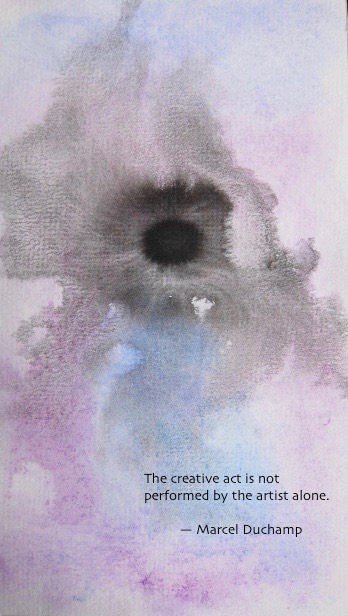
I live for those wild — and strangely peaceful — moments when I am given a rare objective glimpse into the universe of thought.
Am I here?
the fragrant molecule
on a path
to wilderness
Question Michelle Tennison, Answer Richard Gilbert (2017)
The concept of Ma is central to the Japanese haiku aesthetic. Richard Gilbert’s Poems of Consciousness and the interviews with contemporary Japanese poets found therein helped bring this difficult-to-pin down concept to the West. The translators of one of these interviews with Hasegawa Kai define Ma in terms such as
space — ‘betweenness,’ alternate dimension or time, a psycho-poetic interval of betweenness — non-literal reality arising as resonance, between and through words, and beyond them.”
This gap or space between images, elements, and/or ideas created by “cutting,” whether as juxtaposition or disjunction (see Richard Gilbert’s remarkable The Disjunctive Dragonfly to really explore this exciting poetic territory) is pretty much the soul of haiku, and it is why we as fans of of the genre can keep coming back to a haiku again and again and continue to encounter something new there, depending upon where we find ourselves at that moment in our lives.
Clearly there is something similar going on here with the gap between questions and answers in the Surrealist Q&A Game, with its communally creative space that gives the sense of being infinitely possible. Could it be that this gap that arises in Mind, this empty space, is where all the fun really is?
Rejecting a sentimental utopia, what is your vision?
The white door between things
Question Richard Gilbert, Answer Michelle Tennison (2017)
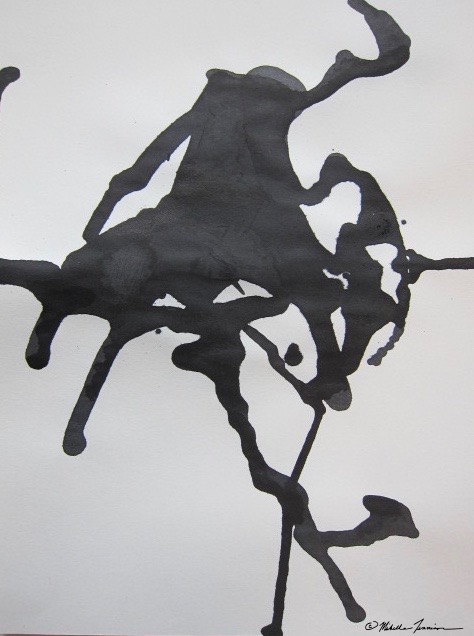
Self Portrait On a Walk Through the Void, Michelle Tennison, ink on paper, 2017
 A Lit Jellyfish
You must be logged in to post a comment.